American Pioneer &
Cemetery Research
Project
Internet
Presentation
101611

One interesting historic mining area
of Arizona, and there are many, is the area of San Domingo Wash and the wash
just east, Trilby Wash. Kevin Hart and I left for our tour early (oh-dark-hundred)
to avoid the heat of the day and we were back by noon.
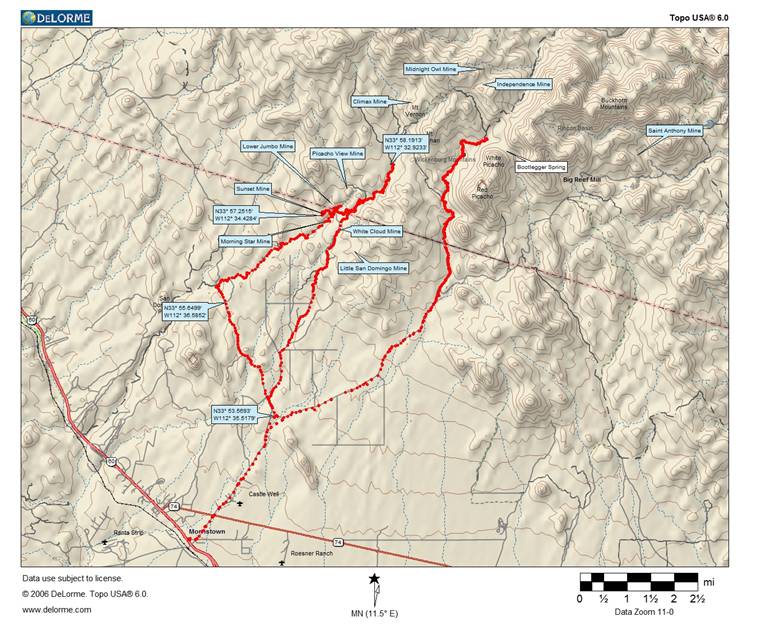
Over the past several years Rusty and
Betty Hasting have told me about the cemeteries and graves along San Domingo
Wash. Recently Bill Cordeiro had found
graves and cemeteries along the wash, I was anxious to find and research the
sites in person.
Such was our quest this 19th day of October
2008. Leaving from Morristown we proceeded NE on Castle Hot Spring Road,
turning to the NW. A short distance later we proceeded down to San Domingo Wash
and followed it north.
Active mines at that time were the Little
San Domingo, Morning Star, White Cloud, Sunset, Picacho View, Lower Jumbo,
Climax, Midnight Owl and Independence Mine will be found near San Domingo Wash.
Presently there is no visible organized
mining activity other than Hobby Mines working placer claims along and in the
wash.
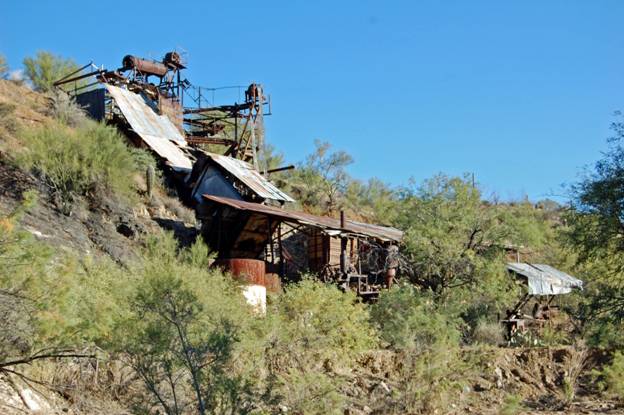
Anderson
Mill, San Domingo Wash. Photo by: Neal Du Shane
A very well preserved Anderson Mill is
along the banks of San Domingo Wash.
Anderson Mill: Caution, the structure is very worn, weathered and
unsafe. There is a nest of Bees or Hornets that have taken residence in the
structure and aren’t receptive to trespassers. Keep a watchful eye for the ever
present Rattlesnakes and Gila Monsters.
Evidence of several small communities
dot the wash and were most likely built to house the miners and owners of the
various mines. The settlements are nothing of any size and probably consisted
of no more than one to four houses plus structures to support the mine near
them. Many foundations are still visible if you take the time to walk the banks
near the mines.
APCRP research has documented and
verified if there is a mine that was operational for any time, there will be
graves near the mine. These graves were probably children, family members or
miners that died for various reasons during the time the mines were
operational. Rarely do we find headstones or markers for these graves but do find
rocks placed to outline the graves. Wild life and cattle move these rocks out
of their original alignment and contrary to popular belief vandals do very
little damage to these historic sites based on our infield research.
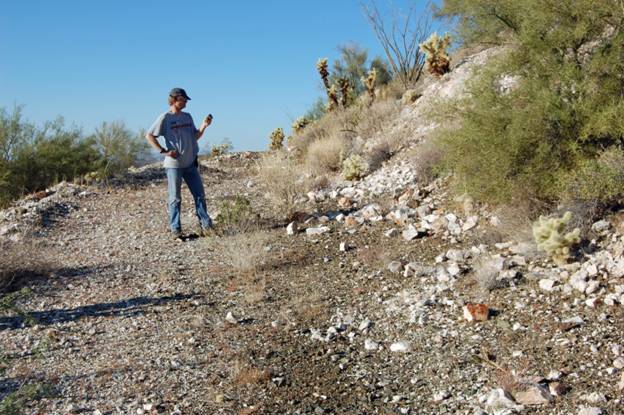
Kevin
Hart, documenting seven graves at the Sunset Mine. Photo by: Neal Du Shane
At the Sunset Mine Kevin and I
discovered seven graves, all adult male, all died in a mine accident at the
same time by an explosion. We are researching to see if we can uncover and
documentation as to the cause of this accident and the time frame it happened.
In addition closer to the Lower Jumbo
Mine there are markers of graves that number six or seven.
Past the Anderson Mill approximately ½
mile, on the west bank of San Domingo Wash are seven graves. Four of which have
cross’s for members of the Underwood family. In addition there are three more
unidentified graves, presumably Underwood family members also. Of the seven
graves there is one female grave. On this flat area along the banks of the wash
there is evidence of houses and structures that dot the banks, indicating
several families may have lived here over the years and worked the mines in the
area.
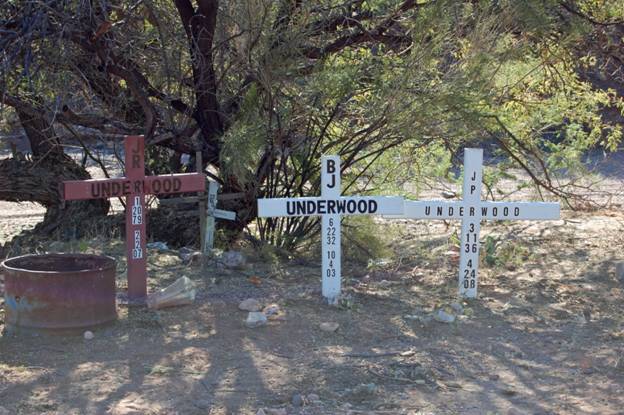
Four of
seven graves along San Domingo Wash. Photo by: Neal Du Shane
Update 10/16/11, Don Witt, Mesa, AZ writes:
I just happened upon your website concerning graves found in the San Domingo
Wash in Arizona. I have some info to give you. In case you have not had
contact with the Underwood family (whose graves you showed in the
photographs) they are a family who hunted deer and Javelina in that area for
50 years or so - not miners or what ever. I personally, hunted with them for
over 15 years or so from 1988 on. The graves are at the corner of the San
Domingo wash and the Eddie wash. Our camp was a little up the Eddie Wash
from there. On the corner (where the graves are) is a miner's homestead. He
was rumored to have been murdered and dumped in a mine. The ruins of his
home are what is evident there. That corner was where Bill Underwood (the
patriarch of the family) used to camp. From what I understand, when the
miner moved there, the family started camping a little further up Eddie
wash.
The marked graves shown belong to Bill and his wife, June, and (I believe) a
grandson who was adopted, JR. They really represent scattered ashes, as I do
not believe any person was actually buried there. The 4th grave belongs to
the family dog, Reggie, who was actually buried there. The survivors include
Bob & Vickie Underwood and family, Litchfield Park, AZ. Bob is Bill's son. I
have very fond memories of hunting with the Underwood family in that area.
They had an old WWII Willis Jeep that we would drive up and down the worst
hills around that area. They welcomed myself and two other (no-family)
hunting companions hunting with their family there for many years. We would
meet there at the camp and drive up the Eddie wash to the "Raster Mine" or
the "Little Divide" or the "Big Divide"...or up the Mitchell wash. Great
memories.
If you have historical information on the graves we would welcome your input. Please contact us at: .
Once our research was complete in San
Domingo Wash we traveled to Trilby Wash and explored the west side of Red and
White Picacho Mountains. We traversed to a point near the Alleged Indian
Massacre site of Col. Jacob Snively. Jack Swilling is documented to have
exhumed Col. Snively’s remains in 1878 and returned the remains to Jack’s Stone
House in Black Canyon City. We have found and documented the remains of Col.
Snively’s remains there. It was rumored there were other soldiers killed with
Col. Snively on that fateful day at White Picacho Mountain. The research I have
completed on Jack Swilling always left me wondering exactly where he traveled
the trip he made to exhume Col. Snively.
Our theory, the travel route for the
three good Samaritans, they would have departed Gillett, traveling west to Tip
Top, west to Swilling Gulch, down Stonewall Gulch to Humbug Creek. Resting a
short time that late afternoon in Columbia, then traveling on to Castle Hot
Springs where they stayed overnight.
Next morning the three proceeded to
White Picacho Mountain to exhume Col. Snively’s remains. Unfortunately in this
act of benevolence, put the three close to Wickenburg to be accused of robbing
a stage coach west of Wickenburg. Jacks outspoken ability to tell a tall tale
led to them being accused of robbing the same stage coach.
Arrested and jailed they were acquitted
in Prescott of the crime. Alas it was discovered they tried the three in
Yavapai County, and the actual robber happened in Maricopa County. Jack was
carted off to the Yuma County Jail for a second trial for which Jack died from
his extremely poor health. I still am amazed what the sweltering heat would be
like in August at the Yuma County Jail in 1878.
American Pioneer & Cemetery Research Project
Internet
Presentation
101611
WebMaster:
Neal Du Shane
Copyright
©2003-2008 Neal Du Shane
All rights reserved. Information contained within this website may be used
for personal family history purposes, but not for financial profit of any kind.
All contents of this website are willed to the American Pioneer & Cemetery
Research Project (APCRP).